Port Energy Management System
The Port Energy Management System addresses critical challenges in port energy operations by establishing a comprehensive centralized monitoring and collaborative control framework covering all operational stages. By integrating multi-source data including energy consumption patterns, equipment status, and carbon emissions, it enables panoramic monitoring and precise analysis of energy usage processes, power supply stability, equipment operational risks, and carbon footprint.
Get Solution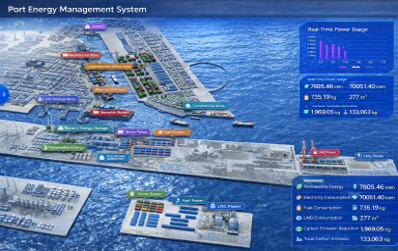
Core Features
Energy Management
Integrates energy monitoring, load forecasting, and carbon footprint tracking data to enable panoramic monitoring and coordinated dispatch of energy usage, power supply balance, carbon emissions, and power supply resources.
Intelligent Operations & Maintenance
Through equipment status sensing, intelligent alarms, and work order-driven closed-loop mechanisms, achieve unified management and task closure of equipment records, inspection plans, maintenance records, and asset lifecycle.
Digital Twin
Utilizes 3D modeling and simulation technology to create virtual mappings of equipment structures, energy systems, and park scenarios, enabling visual restoration of operational status, spatial layout, and operational processes.
Technical Highlights
Panoramic Monitoring and Analysis
Integrates multi-source heterogeneous data including energy monitoring, equipment status, and carbon emissions to provide full-dimensional monitoring and precise analysis of energy processes, equipment risks, and carbon footprint, solving data silo issues.
Intelligent O&M Closed-Loop Management
Standardizes and automates maintenance processes including inspections, work orders, and fault handling, achieving full-process management from alarm triggering, work order dispatch to fault closure.
Refined Low-Carbon Emission Control
Integrates carbon footprint tracking and energy efficiency analysis to provide quantitative assessment and dynamic tracking of carbon emission processes, energy consumption structure, and energy-saving potential.
Target Users
Large port operation and management units, port energy management departments.